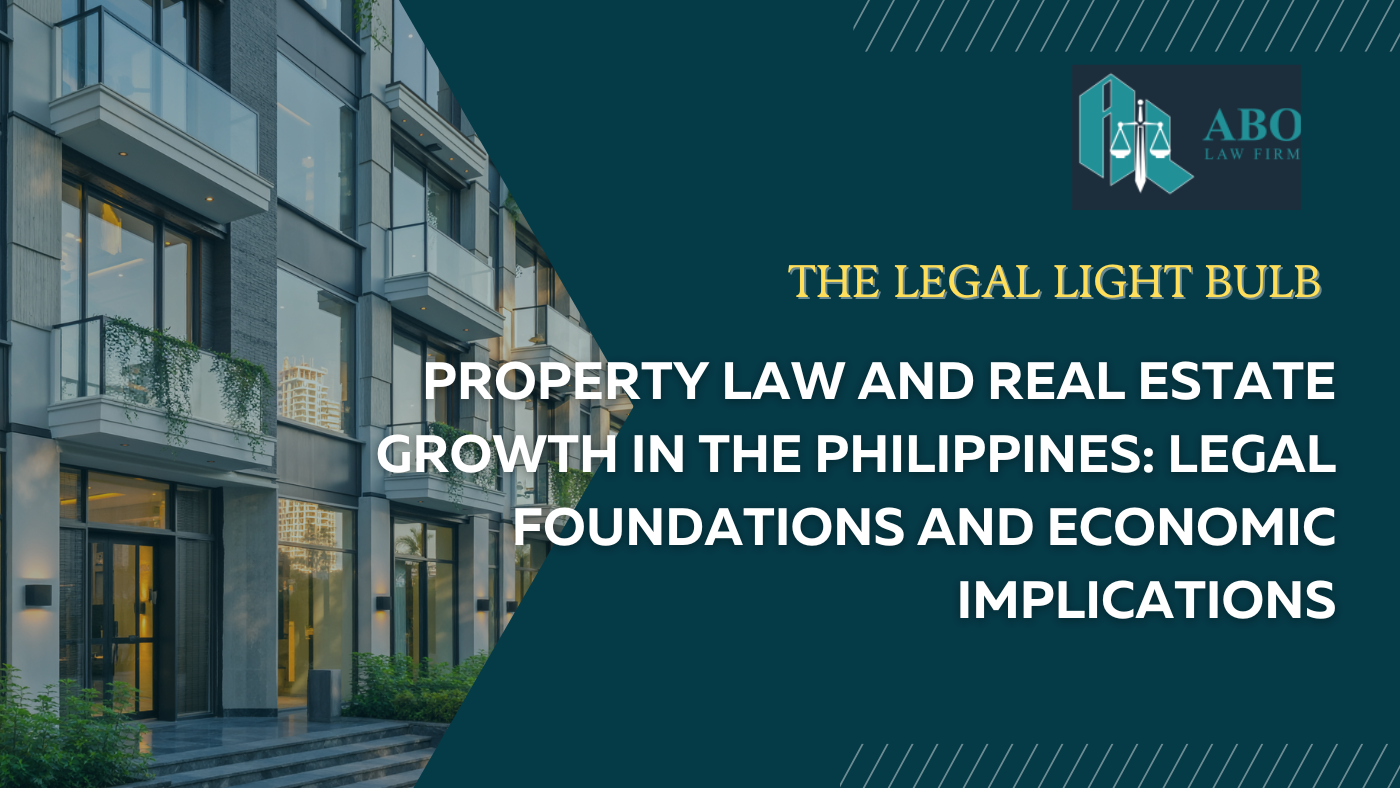
The real estate sector is a critical driver of the Philippine economy, contributing significantly to GDP growth, employment, and urban development. Its trajectory is shaped by the legal frameworks governing condominium ownership, land titling, and agrarian reform, which balance private property rights with social equity. This article examines how these laws influence real estate growth, highlighting statutory provisions and jurisprudence that underpin the sector’s expansion.
Condominium Ownership
The Condominium Act [1]provides the legal foundation for vertical property development. By allowing ownership of individual units separate from the land, it has enabled the proliferation of high-rise residential and commercial projects in Metro Manila and other urban centers.
- Foreign Ownership: Section 5 of R.A. 4726 permits foreign ownership of condominium units, provided that foreign equity in the condominium corporation does not exceed forty (40%, consistent with the constitutional restriction on land ownership.[2]
Land Titling and Registration
Secure land ownership is guaranteed under the Property Registration Decree (Presidential Decree No. 1529), which institutionalized the Torrens system.
- Indefeasibility of Title: Once a certificate of title is issued and becomes incontrovertible after one year, it provides certainty for developers, banks, and buyers.
- Modernization: The Residential Free Patent Act [3]and Agricultural Free Patent reforms[4] have streamlined titling processes, reducing restrictions and expanding access to secure ownership.
- Jurisprudence: In Spouses Jose Manuel and Maria, v. The Register of Deeds,[5] the Court reaffirmed the indefeasibility of Torrens titles, strengthening investor confidence in land transactions.
Agrarian Reform and Land Conversion
The Comprehensive Agrarian Reform Law[6] (CARL as amended by R.A. 9700) redistributes agricultural lands to farmers through Certificates of Land Ownership Award (CLOAs).
- Conversion Rules: Section 65 requires Department of Agrarian Reform (DAR) approval for conversion of agricultural land to residential, commercial, or industrial use.
- Economic Impact: Conversion unlocks land for real estate projects, fueling suburban expansion, but delays in approval can hinder development.
- Case Law: In Luz Farms v. Secretary of Agrarian Reform [7]the Court clarified the scope of agrarian reform, excluding lands devoted to livestock, thereby shaping the boundaries of land redistribution.
- Recent Reforms: The SPLIT Project[8] (Support to Parcelization of Lands for Individual Titling) accelerates subdivision of collective CLOAs into individual titles, enhancing tenure security and enabling beneficiaries to leverage land for credit.
Economic Implications
- Urban Growth: Condominium laws foster vertical expansion, meeting housing demand and attracting foreign capital.
- Market Stability: Torrens titling reduces disputes, facilitates financing, and supports large-scale projects.
- Inclusive Development: Agrarian reform integrates social justice into economic growth, empowering farmers while regulating land conversion for balanced development.
Conclusion
Philippine property law provides the legal scaffolding for real estate growth, ensuring stability, inclusivity, and investor confidence. Condominium ownership laws encourage urban development, land titling secures transactions, and agrarian reform balances equity with expansion. Together, these frameworks make real estate a cornerstone of the Philippine economy, while presenting challenges—such as conversion delays and foreign ownership restrictions—that require careful policy navigation.
Written by: Atty. Rexford C. Resurreccion
[1] (Republic Act No. 4726)
[2] (Article XII, Section 7, 1987 Constitution).
[3] (R.A. 10023)
[4] (R.A. 11573, R.A. 11231)
[5] G.R. No. 224678, July 03, 2018
[6] R.A. 6657
[7] (G.R. No. 86889, 1990),
[8] Department of Agrarian Reform The Support to Parcelization of Lands for Individual Titling (SPLIT) Project is a project of the Department of Agrarian Reform which is being considered for World Bank financing. The Project will involve subdivision of about 1.38 million hectares of collective land titles (Collective Certificate of Land Ownership Awards or CCLOA) into individual land titles. As part of the disclosure requirement under the Environmental and Social Standards of the WB, the following draft of safeguards instruments are posted for our stakeholders information. Comment and inputs on the safeguards instruments are also welcome to ensure better implementation of the SPLIT project